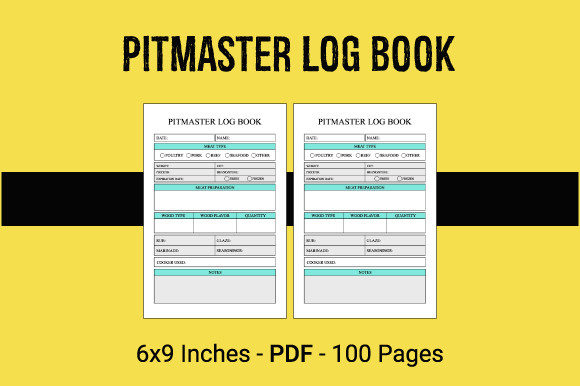
Pitmaster Log Book KDP Interior: Streamlining Your Low-Content Publishing Workflow
For publishers and creators operating within the Amazon Kindle Direct Publishing ecosystem, efficiency is often the defining factor between a stagnant portfolio and a scalable business. The Pitmaster Log Book KDP Interior serves as a foundational asset in this workflow, specifically designed to eliminate the most time-consuming phase of low-content book creation: interior formatting. Rather than spending hours designing grids, temperature charts, and recipe logs from scratch, this ready-to-use PDF file provides a professional, pre-formatted structure that allows you to focus on market research, cover design, and keyword optimization. This 100-page interior is not merely a template; it is a production-ready component that integrates directly into your publishing pipeline.
Understanding the Asset in the Publishing Ecosystem
In the broader context of Print on Demand (POD), the interior file acts as the product’s core utility. While the cover attracts the click, the interior dictates the review score and customer retention. The Pitmaster Log Book KDP Interior fits into the "product development" stage of your business workflow. It bridges the gap between identifying a niche demand for barbecue and smoking journals and having a tangible product available for sale. By utilizing a pre-made, high-resolution PDF, you shift your resources from graphic design to strategic marketing. This asset is particularly valuable for publishers who manage multiple SKUs and need to maintain consistent quality across their catalog without hiring freelance designers for every new release.
This specific logbook targets a passionate hobbyist demographic. Barbecue enthusiasts, competition pitmasters, and home smokers require structured data tracking to improve their craft. They need to record wood types, ambient temperatures, meat internal temps, rest times, and flavor profiles. A generic notebook does not serve this function. Therefore, this interior solves a specific user problem, which aligns with Amazon’s preference for helpful, relevant content over generic filler. When you integrate this file into your workflow, you are essentially deploying a specialized tool that has already been validated for usability and print compliance.
Technical Specifications and Print Compliance
Before uploading any file to KDP, understanding technical constraints is mandatory to avoid rejection or poor print quality. This Pitmaster Log Book KDP Interior is engineered to meet these strict standards automatically. The dimensions are set to 6″ x 9″ inches, which is the industry standard for trade paperbacks and journals. This size offers ample writing space while remaining portable enough for outdoor use at a smoker or grill. The file includes exactly 100 pages, providing substantial value to the end-user while keeping printing costs manageable to protect your royalty margins.
A critical aspect of this digital file is the bleed configuration. It is formatted with No Bleed. In KDP terminology, this means all text and graphics are contained safely within the margins, away from the trim line. This distinction is vital for workflow efficiency because it removes the risk of content being cropped during the printing process. Many amateur publishers struggle with bleed settings, resulting in rejected manuscripts or unprofessional-looking books where lines run off the page. By using a verified no-bleed PDF, you ensure compatibility with KDP’s automated review system, significantly reducing the back-and-forth correction cycle.
The files are provided in High-Resolution PDF format. Resolution matters immensely in POD. Low-quality interiors result in pixelated lines and blurry text, which leads to immediate negative reviews. This high-resolution standard ensures that when the book is printed on Amazon’s standard color or black-and-white paper stock, the lines remain crisp and the text remains legible. This technical reliability allows you to skip the proofing phase or reduces it to a simple digital preview check rather than ordering expensive physical proofs for every iteration.
Integrating the Interior Into Your Production Cycle
The true value of this ready-to-use PDF lies in how it streamlines the pre-publication phase. Typically, creating a logbook involves sketching layouts, digitizing them in Illustrator or Canva, checking margins, and exporting. With this asset, that entire sequence is compressed into minutes. Your workflow shifts from creation to assembly. You download the file, verify the metadata matches your target keywords, and pair it with a custom cover. This speed allows for rapid testing of different niches within the barbecue category. For example, you could create one version targeting "Texas Style Brisket" and another for "Competition BBQ Team Logs," using the same functional interior but different positioning.
Cover Design Synergy: The interior dictates the spine width and overall aesthetic expectations. Since this is a 100-page, 6x9 no-bleed file, you can immediately generate accurate cover templates using KDP’s calculator or third-party tools like Book Bolt or Publisher Rocket. There is no guesswork regarding page count adjustments. Furthermore, knowing the interior style helps inform the cover design. If the interior features rustic, clean lines suitable for a pitmaster, your cover should reflect that utilitarian, masculine, or culinary aesthetic. The interior and cover must feel like a cohesive unit; having the interior finalized first prevents design disconnects.
Quality Control and Pre-Launch Verification
Even with a professional pre-made file, quality control remains a non-negotiable step in a sustainable publishing business. Before hitting publish, integrate a verification checkpoint into your routine. Download the KDP Previewer tool and load both the interior PDF and your cover file. Check specifically for:
- Margin Safety: Ensure that even though it is "no bleed," the writing prompts are far enough from the gutter (inner margin) so they aren't swallowed by the binding.
- Page Count Alignment: Confirm the PDF is exactly 100 pages and matches your cover template specifications.
- Visual Clarity: Zoom in to 100% in the previewer to verify line sharpness.
- Metadata Consistency: Ensure your title and subtitle accurately describe a "Pitmaster Log Book" to match the interior content, avoiding misleading metadata claims.
This QC process takes less than fifteen minutes but safeguards your account health. Amazon penalizes publishers for poor customer experiences. By treating this ready-to-use file as a professional component requiring final inspection rather than a magic button, you maintain high standards and build long-term brand equity.
Strategic Positioning and Market Application
Owning the file is only half the equation; understanding where it fits in the market is the other. The Pitmaster Log Book KDP Interior is versatile enough to support various sub-niches. During your keyword research phase, consider how this specific layout applies to different user intents. Is it better suited for a "Smoker Temperature Tracker," a "BBQ Recipe Journal," or a "Grilling Gift for Dad"? The interior’s functionality supports all these angles, but your success depends on matching the right angle to search volume.
Consider the seasonality of this asset. Barbecue interest peaks in late spring and summer. Integrating this interior into your Q1 and Q2 planning allows you to have products indexed and ranked before the rush. Conversely, during the off-season, this same interior can be repositioned for indoor smoking, oven roasting, or general culinary experimentation. The static nature of the PDF does not limit its dynamic application in marketing. You can also bundle this conceptually with other related low-content books, such as butcher cut guides or spice blend journals, to create a series. Series branding increases read-through rates and average order value.
Long-Term Asset Management and Scalability
For entrepreneurs and freelancers building a passive income stream, asset management is key to scalability. Store this Pitmaster Log Book KDP Interior in a structured digital asset management system. Tag it with relevant attributes: "6x9," "No Bleed," "100 Pages," "BBQ Niche," "Logbook." When you decide to expand your portfolio six months from now, retrieving this file should be instantaneous. Do not rely on scattered downloads folders. Organized assets reduce friction when you identify a new opportunity or need to update an existing listing.
Furthermore, track the performance of books created with this specific interior. Use sales data to validate whether the layout resonates with customers. If a particular variation sells well, you know the interior usability is sound, and you can confidently invest more in advertising or cover variations. If sales are low despite good traffic, the issue may lie in the cover or keywords, not the interior itself. Having a standardized interior variable isolates other factors in your A/B testing. This analytical approach transforms a simple PDF file into a data point for business intelligence.
Ultimately, the Pitmaster Log Book KDP Interior represents a balance between automation and quality. It removes the technical barriers to entry for the barbecue journal niche while maintaining the professional standards required to compete on Amazon. By focusing your energy on the strategic elements of publishing—research, design, marketing, and analysis—and leveraging high-quality pre-made interiors for the structural heavy lifting, you build a more resilient and efficient KDP business. Whether you are a seasoned publisher looking to streamline operations or a new creator entering the hobbyist journal space, this digital file provides the reliable foundation necessary for sustainable growth.