Book Review Journal for KDP Interior: A Publishing Asset
Launching a successful low-content publishing business on Amazon requires more than just uploading generic templates; it demands high-quality, niche-specific interiors that solve actual problems for readers. The Book Review Journal for KDP Interior serves as a foundational asset for publishers targeting the lucrative bibliophile and literary community. Rather than spending dozens of hours designing layouts from scratch or risking copyright issues with unverified free resources, this pre-made interior package provides a professional, print-ready solution. It bridges the gap between creative ambition and technical execution, allowing self-publishers to focus on marketing and keyword research rather than graphic design mechanics.
For entrepreneurs and creators aged 20 to 50, time is often the most scarce resource. Whether you are a freelancer building a passive income stream, an educator creating supplemental materials, or a hobbyist documenting your reading journey, this journal interior offers immediate utility. It is structured specifically for the 8.5 x 11-inch trim size, which remains the industry standard for comprehensive journals. However, the true value lies in its versatility. Because the files are vector-based and fully editable, they adapt to various niches beyond simple book tracking, including library logs, student reading records, and author research notebooks.
Technical Specifications and File Versatility
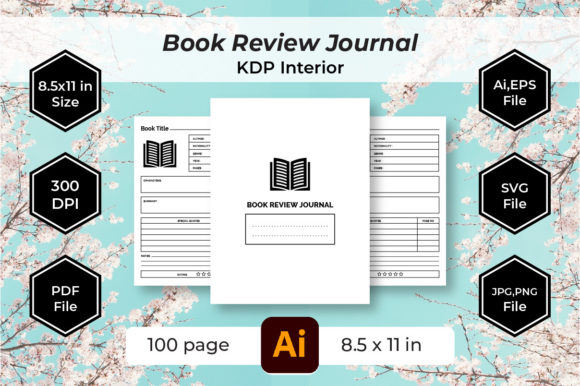
The strength of any KDP interior lies in its technical quality. Blurry text or pixelated graphics result in negative reviews and returns. This Book Review Journal for KDP Interior is engineered at 300 DPI, ensuring crisp lines and legible typography when printed on demand. The package includes a 100-page PDF file that is ready for immediate upload, but the inclusion of source files is what separates this product from basic templates.
- Editable AI Source File: Allows complete customization of layout, fonts, and elements using Adobe Illustrator.
- Vector EPS Files: Ensures infinite scalability without quality loss, perfect for resizing to different trim sizes like 6x9 or A5.
- SVG and PNG Assets: Useful for creating matching social media graphics, Etsy listing images, or digital planner stickers.
- High-Quality JPGs: Provides quick previews for marketing materials or portfolio displays.
Having access to the editable source file transforms this from a static product into a dynamic brand asset. Publishers can modify headers to match their specific series branding, adjust margin sizes to accommodate gutter shifts, or add unique prompts that differentiate their book from competitors. This level of control is essential for building a recognizable brand identity in the crowded low-content market.
Practical Applications Across Niches
While labeled as a book review journal, the interior’s structure supports diverse use cases. Understanding these applications helps in targeting long-tail keywords and reaching specific sub-audiences. For educators and homeschoolers, this journal functions as a reading comprehension tool where students track genres, summarize plots, and record vocabulary. In this context, the rating and quote sections become educational metrics rather than mere opinions.
For professional reviewers, bloggers, and influencers, the journal acts as a content calendar and database. Tracking publication dates, authors, and genres helps maintain consistency in posting schedules. The physical act of writing reviews often aids memory retention better than digital apps, making this analog tool valuable for serious critics. Additionally, authors themselves use similar interiors to track competitive titles, noting tropes, pacing, and cover trends within their genre. By marketing this interior to multiple demographics—readers, students, reviewers, and writers—you maximize the potential return on investment for a single design asset.
Strategic Customization for Market Differentiation
Saturation is a common concern in KDP publishing. To succeed, you must offer something distinct. The customizable nature of this Book Review Journal for KDP Interior allows for strategic differentiation. Instead of using the default layout, consider modifying specific fields to target underserved micro-niches. For example, replacing general "Rating" stars with specific criteria like "World Building," "Character Development," or "Spice Level" appeals directly to fiction readers in fantasy or romance genres.
Non-fiction readers require different data points. Adapting the interior to include sections for "Key Takeaways," "Action Items," or "References" creates a specialized knowledge management journal. This pivot targets professionals and lifelong learners who read for self-improvement rather than entertainment. Because the source files are included, these changes take minutes rather than days. This agility enables rapid testing of new niches without additional design costs.
Evaluating Quality and Print Readiness
Before publishing any low-content book, rigorous quality assurance is non-negotiable. Even with a high-quality template like this, user error during customization can lead to printing failures. Always verify that margins meet KDP’s current specifications for your chosen page count and paper type. The 8.5 x 11 format provides ample space, but if you resize the vector files to a smaller dimension, ensure all text remains readable and safe zones are respected.
Check the contrast of all elements. While the provided files are 300 DPI, certain e-readers or preview tools may display them differently. Print a physical proof copy before launching to test the paper opacity and binding. Low-content books live or die by their user experience; if the paper bleeds through or the gutter swallows the writing space, customers will notice. Utilizing the high-resolution JPG and PNG files to create accurate mockups also manages customer expectations, reducing returns due to misleading cover representations.
Enhancing User Experience and Engagement
A successful journal interior guides the user without overwhelming them. The best Book Review Journal for KDP Interior designs balance structure with freedom. Structured fields like Author, Genre, and Date provide necessary organization, while open spaces for quotes and reflections encourage creativity. When customizing this template, maintain this equilibrium. Too many mandatory fields make journaling feel like homework; too few make it difficult to retrieve information later.
Consider adding instructional pages or index tabs at the beginning of the journal. These value-adds improve usability and justify a higher price point. The included SVG and PNG files can be repurposed to create decorative dividers or category markers that enhance navigation. For digital sellers offering printable versions alongside physical KDP books, these assets are crucial for creating cohesive bundles. Engagement increases when users feel the product was designed with their specific workflow in mind, leading to organic reviews and word-of-mouth promotion.
Building a Sustainable Publishing Workflow
Incorporating premium assets like this journal interior streamlines the production pipeline. For freelancers and agency owners managing multiple KDP accounts, consistency reduces cognitive load. Using standardized, high-quality interiors ensures every release meets professional benchmarks. This reliability builds trust with buyers who recognize your imprint as a source of quality low-content books.
Furthermore, owning the commercial rights and source files protects your business long-term. Platform policies change, and reliance on third-party subscription services carries risk. Having local, editable master files grants autonomy. You can update designs to comply with new guidelines, refresh covers seasonally, or expand into related products like bookmarks or reading trackers using the same visual language. This holistic approach turns a single purchase into a scalable business component, supporting sustainable growth in the competitive self-publishing landscape.