Evaluating the KDP Interior - Jewellery Making Journal for Print on Demand
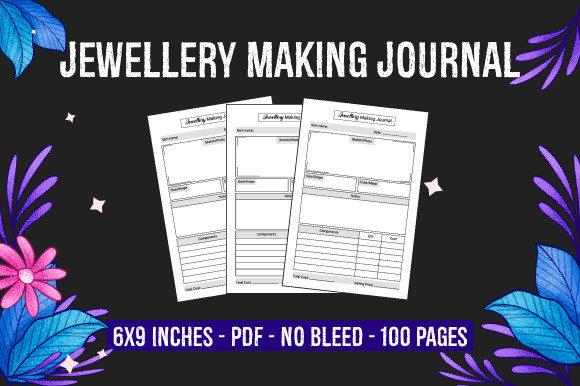
The low-content and medium-content publishing sector on Amazon has matured significantly, moving beyond generic lined notebooks toward specialized utility journals. For creators targeting specific hobbies or professional niches, the KDP Interior - Jewellery Making Journal represents a strategic asset rather than just another blank book template. This digital resource provides a pre-formatted, 100-page interior designed specifically for artisans, hobbyists, and small business owners in the jewelry design space. By offering a ready-to-use PDF file with precise 6″ x 9″ dimensions and no-bleed formatting, it addresses one of the most significant friction points in Print on Demand (POD): technical compliance and niche relevance.
For publishers and entrepreneurs aged 20 to 50 who are building a portfolio of functional books, understanding the practical application of this interior is essential. It is not merely a collection of pages; it is a structured tool intended to solve organization problems for jewelry makers. Evaluating this product requires looking past the marketing claims to assess its usability, print readiness, and potential market fit within the current KDP ecosystem.
Functional Design and Niche Specificity
The primary value proposition of the KDP Interior - Jewellery Making Journal lies in its specificity. Generic graph paper or dot grid journals fail to capture the unique workflow of jewelry creation, which involves tracking materials, sketching designs, recording measurements, and managing inventory. A dedicated interior bridges this gap by providing structured prompts and layouts that mirror the actual creative process.
When evaluating the 100-page layout, effective interiors typically include sections for:
- Design Sketch Areas: Space allocated for visual concepts alongside technical notes.
- Material Tracking: Tables for logging gemstones, metals, wire gauges, and supplier details.
- Project Specifications: Dedicated fields for dimensions, weight, and finishing techniques.
- Costing and Pricing: Sections to calculate material costs versus labor to determine retail pricing.
- Idea Banks: Lined or prompted areas for capturing inspiration and future project concepts.
This level of detail transforms the book from a passive notebook into an active business and creative management tool. For the POD seller, this specificity reduces competition. While there are thousands of "sketchbooks," there are far fewer comprehensive jewelry design logs. The interior serves as a filter, attracting buyers who are actively seeking a solution to organize their craft, rather than those browsing aimlessly.
Technical Compliance and Print Readiness
A common failure point for new KDP publishers is uploading files that trigger rejection errors or result in poor print quality. The KDP Interior - Jewellery Making Journal mitigates these risks through standardized technical specifications. The 6″ x 9″ trim size is the industry standard for trade paperbacks, offering a portable form factor that fits easily into a maker’s bag or studio desk without being cumbersome.
The "No Bleed" specification is particularly advantageous for this niche. Jewelry journals often rely on crisp lines, tables, and text boxes. Bleed interiors require margins to extend 0.125 inches beyond the trim line, which can complicate formatting and increase the risk of content being cropped during the binding process. A no-bleed setup ensures that all structural elements remain safely within the safe zone, resulting in a cleaner, more professional appearance for technical content. Furthermore, high-resolution PDF output ensures that fine lines used for sketching grids or detailed tables do not appear pixelated or fuzzy in print. Clarity is non-negotiable for users who need to write small annotations regarding metal purity or stone carat weights.
Workflow Integration for Publishers
For freelancers, marketers, and small business owners utilizing KDP as a revenue stream or brand extension, time efficiency is critical. Creating a custom 100-page interior from scratch requires proficiency in software like Adobe InDesign or Affinity Publisher, alongside hours of layout testing. The ready-to-use nature of this KDP Interior - Jewellery Making Journal allows publishers to bypass the production phase entirely.
The workflow integration looks like this:
- Acquisition: Download the verified PDF file.
- Cover Creation: Design a cover that matches the 6″ x 9″ no-bleed spine width calculation based on page count.
- Upload: Submit both files to KDP.
- Proofing: Review the digital proof to ensure margin alignment.
- Publish: Set metadata and pricing.
This streamlined process enables rapid iteration. Publishers can test multiple cover designs against the same high-quality interior to see which aesthetic resonates with the jewelry community. It also allows for portfolio diversification; a creator focusing on craft niches can release complementary titles (e.g., Beading Log, Metalsmithing Planner) using consistent interior frameworks to build brand recognition.
Audience Fit and Practical Application
Understanding who actually uses this journal is vital for effective marketing and keyword selection. The target audience for the KDP Interior - Jewellery Making Journal extends beyond casual hobbyists. Key user segments include:
- Professional Artisans: Makers selling on Etsy or at craft fairs who need to track COGS (Cost of Goods Sold) and maintain consistency across collections.
- Jewelry Students: Individuals in design programs requiring a structured format to document learning progress and technique mastery.
- Serious Hobbyists: Enthusiasts investing significant capital in materials who want to catalog their stash and project history.
- Educators and Workshop Leaders: Instructors who may recommend specific organizational tools to students as part of a curriculum.
For these users, the journal acts as a repository of intellectual property and business data. When marketing this book, publishers should emphasize utility over aesthetics. Keywords and descriptions should focus on terms like "jewelry inventory tracker," "design logbook," "metalsmithing planner," and "bead organizer" rather than generic terms like "gift for jeweler." The value is in the function.
Assessing Quality and Long-Term Viability
While pre-made interiors offer convenience, they must be evaluated critically. Not all stock interiors are created equal. When assessing the KDP Interior - Jewellery Making Journal, publishers should verify several quality indicators before listing.
First, check the margin consistency. Technical journals require ample gutter space (the inner margin near the spine) because users often write in tables or sketch across two pages. If the gutter is too narrow, the book becomes unusable when bound. Second, evaluate the paper opacity implications. Although KDP standard paper is 55# (90 GSM), heavy ink usage on sketch pages can cause bleed-through. High-quality interiors account for this by avoiding solid black backgrounds or overly dense graphics that exacerbate transparency issues.
Long-term viability also depends on uniqueness. As the POD market grows, duplicate content penalties become a concern. Publishers using this ready-to-use PDF should consider adding value to differentiate their edition. This could involve creating a custom introduction, adding a resource list of jewelry suppliers, including conversion charts for wire gauges, or designing a highly distinctive cover that signals premium quality. Treating the stock interior as a foundation rather than the final product helps maintain competitiveness and protects against market saturation.
Limitations and Realistic Expectations
It is important to maintain a balanced perspective regarding what this digital file can achieve. The KDP Interior - Jewellery Making Journal is a static template. It cannot be customized per user, nor does it offer digital interactivity. Users accustomed to apps like Procreate or specialized inventory software may find a physical paper journal limiting for certain tasks. Additionally, because this is a pre-made asset, other publishers may be using the exact same interior. Success will largely depend on superior cover design, better keyword research, and stronger off-platform marketing rather than the interior alone.
Furthermore, the 100-page count is a fixed constraint. Some professionals may prefer thicker volumes for annual tracking, while beginners might find 100 pages intimidating. Publishers should clearly communicate the page count and intended use case in their book description to manage buyer expectations and reduce returns. Transparency builds trust, which is essential for long-term success in the KDP space.
Strategic Value for Creative Entrepreneurs
Ultimately, the KDP Interior - Jewellery Making Journal serves as a pragmatic tool for entrepreneurs looking to enter or expand within the craft niche. It removes technical barriers, ensures professional formatting, and targets a passionate audience with specific organizational needs. For adults balancing creative pursuits with business responsibilities, it offers a viable path to product creation without the steep learning curve of graphic design.
By focusing on the intersection of quality, utility, and niche relevance, publishers can leverage this resource to build a sustainable catalog. The key lies in viewing the interior not as a commodity, but as a component of a broader value proposition that serves the genuine needs of the jewelry making community. When executed with attention to detail and market awareness, this ready-to-use file facilitates a professional publishing workflow that respects both the creator's time and the end-user's craft.