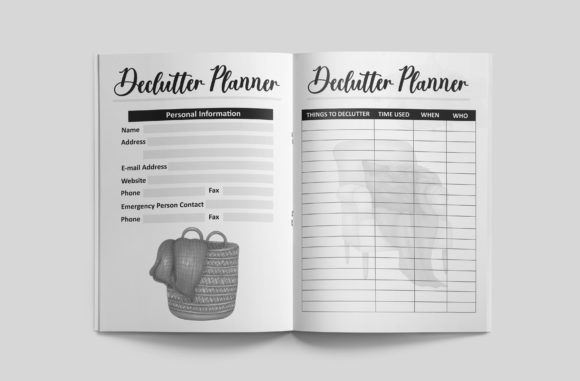
Evaluating the Declutter Log Book Planner KDP Interior for Low Content Publishing
Selecting the right interior template is often the most critical technical decision for Amazon KDP publishers in the low-content niche. When considering a Declutter Log Book Planner KDP Interior, specifically formatted at 8.5 x 11 inches with no-bleed specifications, publishers must weigh functional utility against market saturation. This specific format serves as a foundational tool for end-users attempting to organize their living spaces, but for the publisher, it represents a balance between ease of production and the necessity of differentiation. Understanding the distinct characteristics of this PDF resource helps determine whether it aligns with your current publishing strategy or if alternative formats might better serve your target audience.
Defining the Functional Scope of the No-Bleed Format
The primary distinction of this specific Declutter Log Book Planner KDP Interior lies in its "no bleed" configuration. In KDP terminology, no bleed means that all text, lines, and graphics are contained within a safe margin, typically 0.375 inches from the trim edge on the outer sides and slightly more on the gutter. This differs significantly from full-bleed interiors where design elements extend to the very edge of the paper. For a decluttering planner, the no-bleed format offers practical advantages during the printing process. It reduces the risk of content being trimmed off due to minor mechanical shifts during manufacturing, ensuring that checkboxes, inventory tables, and donation logs remain fully legible and intact.
From a user experience perspective, the 8.5 x 11 inch size provides ample surface area for detailed logging. Unlike smaller A5 or 6x9 journals, this letter-size format allows for comprehensive tracking columns. Users can record item descriptions, categories (keep, donate, sell, trash), estimated values, and disposal dates without feeling cramped. This spaciousness is particularly relevant for decluttering projects involving high-volume areas like garages, basements, or estate liquidations. However, publishers should recognize that this larger footprint also implies higher printing costs per unit compared to smaller trim sizes, which directly impacts royalty margins and pricing strategies.
Comparative Analysis: Digital Apps vs. Physical Logging
When evaluating the market fit for a physical Declutter Log Book Planner KDP Interior, it is essential to compare it against digital alternatives. Many consumers now use spreadsheet software, note-taking apps, or specialized decluttering applications to track progress. These digital tools offer searchability, cloud syncing, and photo integration features that a printed PDF cannot replicate. Consequently, a physical planner must offer value propositions that digital tools lack to remain competitive.
The strength of the physical log book lies in cognitive engagement and tactile accountability. Research into habit formation suggests that handwriting can improve memory retention and commitment to goals compared to typing. For an audience aged 20–50, many of whom experience screen fatigue, a paper-based system provides a necessary disconnect from digital devices while performing a physical task. Furthermore, a physical book does not require batteries, Wi-Fi, or subscriptions. When positioning this product, the comparison should not focus on technological superiority but rather on mindfulness, permanence, and the psychological satisfaction of physically checking off completed tasks. If your target demographic prioritizes efficiency and data analysis, a digital solution may be superior; if they prioritize behavioral change and tangible progress, the physical interior is the stronger choice.
Differentiation Strategies and Cover Integration
A significant challenge with using pre-made KDP interiors is the potential for duplicate content issues. Amazon’s algorithm favors unique products, and multiple books sharing identical internal pages may compete directly against one another or face visibility suppression. The instruction to create a unique front cover and merge it with the PDF is not merely a suggestion for aesthetic variety; it is a fundamental requirement for product viability. The cover acts as the primary metadata signal to both the customer and the algorithm, distinguishing your specific version of the Declutter Log Book Planner KDP Interior from others utilizing the same base file.
Beyond the cover, publishers should evaluate whether the base PDF requires modification to enhance uniqueness. While the provided file offers a complete structure, adding proprietary elements can increase value. This might include inserting motivational quotes between sections, adding a personalized introduction page, creating custom category indexes, or including supplementary checklists specific to certain rooms or seasons. Merging these additions with the core PDF creates a composite product that is distinct from the raw template. This approach mitigates the risk of selling a commodity and transforms the interior into a branded resource. Publishers who simply upload the unmodified PDF with a generic cover are unlikely to achieve sustainable sales velocity in a mature marketplace.
Assessing Tradeoffs and Limitations
While the 8.5 x 11 no-bleed format is versatile, it carries inherent tradeoffs that must be acknowledged during the evaluation phase. The most prominent limitation is portability. Decluttering is an active, mobile task; users move between rooms, carry items to vehicles, and sort through storage bins. A large-format book can be cumbersome to hold while working, unlike a pocket-sized notebook or a phone. Publishers targeting users who need to log items *in situ* might find that this size creates friction. Conversely, this size excels as a "command center" document used at a desk or kitchen table to plan sessions and review aggregate progress.
Another consideration is the rigidity of the pre-formatted layout. A standardized Declutter Log Book Planner KDP Interior assumes a universal approach to organization. However, decluttering methodologies vary widely, ranging from minimalist approaches to detailed inventory management for insurance purposes. If the interior’s columns do not match the user's specific methodology, the book becomes obsolete. Publishers must critically assess whether the provided fields (e.g., item name, destination, date) are broad enough to accommodate various organizational philosophies or too specific to a single niche. Flexibility often sells better than rigid structure in this category, as it allows the user to adapt the tool to their evolving needs.
Determining Best-Fit Scenarios
This specific interior resource is best suited for publishers aiming to serve the general home organization market or those creating bundled resources for life transitions. It performs well when positioned as part of a larger ecosystem, such as a moving preparation kit, an estate settlement guide, or a spring cleaning companion. In these contexts, the 8.5 x 11 size matches standard document storage and integrates seamlessly with other paperwork associated with these events. The no-bleed specification further supports this professional, document-like feel, making it appropriate for users who view decluttering as a project management task rather than a casual journaling activity.
Conversely, this interior may be a poor fit for niches requiring high emotional processing or artistic expression. Grief-related decluttering or creative organizing often benefits from blank space, prompts, and softer layouts that differ from the structured, tabular nature of a standard log book. Additionally, if your research indicates that your specific sub-niche prefers premium aesthetics with edge-to-edge design, the no-bleed constraint will limit your ability to deliver that visual experience. Understanding these boundaries prevents misalignment between the product capabilities and audience expectations.
Evaluating Production Quality and User Experience
Technical execution plays a massive role in the reception of KDP interiors. When utilizing a Declutter Log Book Planner KDP Interior, publishers must verify line weights and contrast. Standard KDP black and white printing can sometimes render thin lines faintly or inconsistently. Before finalizing the merge with your unique cover, print a proof copy to test the usability of the writing spaces. Ensure that the paper quality supports the intended writing instruments; while KDP standard paper is suitable for pencils and ballpoints, it may bleed with gel pens or markers regardless of the "no bleed" design setting. Communicating these limitations or optimizing the interior for standard office supplies can prevent negative reviews related to functionality.
Furthermore, consider the pagination and binding mechanics. An 8.5 x 11 book with a high page count can suffer from gutter loss, where content disappears into the spine. Although no-bleed designs account for margins, publishers should double-check that the inner margin is sufficient for the total page count of the merged file. A decluttering log that requires excessive force to lay flat or obscures data in the binding will frustrate users engaged in an already stressful activity. Ensuring technical excellence in the final PDF assembly is as important as the conceptual design of the cover.
Making an Informed Selection Decision
Ultimately, the decision to use this Declutter Log Book Planner KDP Interior should be driven by specific market research rather than convenience. Compare this option against creating a custom interior from scratch or licensing alternative templates. Evaluate the cost-benefit ratio: does the time saved by using this pre-made 8.5 x 11 no-bleed PDF outweigh the effort required to differentiate it sufficiently? If you possess strong graphic design skills and deep niche knowledge, a custom interior might yield higher long-term defensibility. However, if speed to market is the priority and you have a validated strategy for cover differentiation and keyword targeting, this resource provides a solid, professional foundation.
Publishers should also stay attuned to evolving trends in the organization niche. Consumer preferences shift between maximalist detail and minimalist simplicity. Regularly reviewing feedback on similar products and staying connected with resource providers ensures that your chosen interiors remain relevant. By treating this PDF as a component of a broader publishing strategy rather than a standalone solution, you can effectively navigate the complexities of the KDP marketplace and deliver genuine value to adults seeking to reclaim their physical spaces.