Elevating Low Content Publishing with the Childcare Register Logbook KDP Interior
The landscape of self-publishing has undergone a significant transformation in recent years. What began as a platform primarily for text-heavy novels and non-fiction guides has evolved into a robust marketplace for functional, utility-driven publications. Among the most resilient and profitable niches within this ecosystem is the low-content book sector, specifically resources designed for professional organization and compliance. For entrepreneurs and creators looking to establish a sustainable presence on Amazon KDP, the Childcare Register Logbook KDP Interior represents more than just a template; it is a strategic entry point into a market driven by regulatory necessity and professional standards.
Understanding the value of this specific interior requires looking beyond the mechanics of printing and binding. It demands an appreciation of the childcare industry's operational realities, the shifting expectations of modern parents, and the technological workflows that define successful digital publishing businesses today. This article explores why high-quality, editable interiors are becoming the cornerstone of serious KDP ventures and how leveraging vector-based assets can streamline production while maximizing market relevance.
The Intersection of Compliance and Commerce in Early Education
To understand the commercial viability of a Childcare Register Log book KDP Interior, one must first understand the end-user. Childcare providers, daycare centers, and home-based educators operate in a highly regulated environment. Attendance tracking is not merely an administrative suggestion; it is often a legal requirement tied to licensing, funding, and safety protocols. Unlike creative journals or open-ended planners where user engagement is optional, a register logbook serves a mandatory function. This inherent utility creates a baseline demand that is less susceptible to seasonal trends or fleeting fads.
However, the market is also responding to changing consumer preferences. Modern parents expect transparency and professionalism from care providers. A well-organized, aesthetically pleasing logbook signals competence and attention to detail. Consequently, KDP creators are no longer competing solely on price; they are competing on design quality and functional layout. The days of uploading generic, pixelated tables are ending. Successful publishers are utilizing premium Childcare Logbook Interior designs that balance ample writing space with intuitive navigation, ensuring that the physical product enhances rather than hinders the daily workflow of a busy educator.
Why Editable Source Files Matter for Scalability
A critical differentiator in the current KDP landscape is customization. While pre-made PDFs offer convenience, they limit long-term business growth. This is why access to an Editable Source File Ai and Vector Source File EPS is paramount for serious publishers. These formats allow creators to modify layouts, adjust margins, update headers, or rebrand the entire interior without starting from scratch.
Consider the practical application: A creator might launch a standard attendance log using the base Childcare Register Interior. Six months later, market research might indicate a rising demand for bilingual childcare resources or specific state-compliant formatting. With vector source files, adapting the existing asset takes minutes rather than days. This agility is essential in a marketplace where search algorithms favor fresh content and niche specificity. Furthermore, having 2 SVG File and 2 PNG File assets allows for cross-platform marketing. Creators can use these high-resolution graphics for social media promotion, Etsy listing mockups, or even digital download products, creating multiple revenue streams from a single design acquisition.
Technical Standards and Print Quality as Competitive Advantages
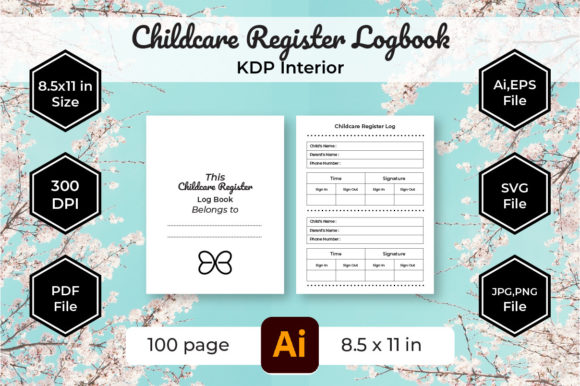
In the realm of low-content publishing, technical specifications directly correlate with customer satisfaction and review ratings. A common pitfall for new entrants is neglecting print readiness. The Childcare Register Logbook KDP Interior discussed here addresses this by adhering to strict professional standards, including 300 DPI resolution and precise 8.5 x 11 inches sizing. These metrics ensure crisp lines and legible text, which are non-negotiable for a document intended for daily handwriting and record-keeping.
The inclusion of a 100 Page PDF File provides a substantial volume that justifies a higher price point while offering genuine value to the user. However, the ability to resize the file is equally important. While 8.5 x 11 is the industry standard for registers, some niches prefer smaller, portable formats for field trips or home visits. Vector-based interiors maintain their integrity regardless of scaling, preventing the blurriness that plagues raster-only templates. This technical flexibility allows publishers to test different trim sizes without incurring additional design costs, facilitating data-driven decisions based on sales performance across various form factors.
Aligning with Broader Industry Trends
The rise of specialized KDP interiors mirrors larger shifts in the gig economy and small business management. As more individuals enter the freelance childcare and private education sectors, the need for affordable, professional-grade administrative tools has surged. These professionals often lack the budget for custom graphic design but require materials that look bespoke. A high-quality Kdp Template bridges this gap, democratizing access to professional branding.
Furthermore, there is a growing trend toward hybrid analog-digital workflows. While many aspects of childcare management have moved to apps, physical backups remain a best practice for data security and power-outage contingencies. By positioning a Register Log Book as a reliable analog companion to digital systems, creators tap into a mindset of redundancy and safety. This contextual relevance transforms a simple notebook into an essential component of a comprehensive risk management strategy for childcare providers.
Strategic Tagging and Discoverability in a Saturated Market
Creating a superior product is only half the battle; visibility is the other. The metadata associated with a Childcare Register Logbook KDP Interior plays a crucial role in connecting the right product with the right buyer. Effective tagging goes beyond generic terms like "notebook" or "journal." It involves understanding the semantic vocabulary of the target audience.
Tags such as Best Planner For Log Book, Daily Schedule, and Kids Interiors capture specific search intents. A user searching for "Daily Schedule" may be looking for a classroom management tool rather than just an attendance sheet, presenting an opportunity to cross-sell or position the register as a multi-functional resource. Similarly, terms like Low Content Interiors and Kdp Planner Interiors appeal to B2B buyers—other publishers or resellers looking for commercial-use assets. By optimizing for both end-users and fellow creators, a single product listing can serve dual markets.
It is also vital to recognize the evolution of keyword relevance. Terms like Customizable Pdf and Editable Pdf signal added value to sophisticated buyers who understand the difference between static and dynamic files. In an era where AI-generated content is flooding the market, emphasizing human-centric design elements and professional editability helps distinguish legitimate, high-quality resources from automated spam. This distinction is increasingly important as platforms refine their algorithms to prioritize helpful, user-focused content over mass-produced filler.
Future-Proofing Your KDP Business Model
Sustainability in self-publishing comes from building assets, not just books. When you acquire a comprehensive package that includes Interiors Kdp source files, you are investing in intellectual property that can evolve. The childcare sector itself is dynamic; regulations change, educational philosophies shift, and aesthetic trends cycle. A static PDF becomes obsolete; a vector source file adapts.
For marketers and freelancers managing multiple KDP accounts or client portfolios, this adaptability reduces overhead and accelerates time-to-market. Instead of commissioning new designs for every seasonal variation or regional requirement, existing assets can be repurposed. This efficiency allows for broader experimentation and faster iteration cycles, which are hallmarks of successful digital entrepreneurship.
Moreover, the emphasis on high-quality visuals (2 High-quality JPG File) supports external marketing efforts. Driving traffic to Amazon listings often requires compelling visuals on Pinterest, Instagram, or dedicated blogs. Having professional-grade promotional assets included with the interior purchase eliminates the friction of creating separate marketing materials, ensuring brand consistency across all touchpoints.
Conclusion: Value Beyond the Page
The Childcare Register Logbook KDP Interior exemplifies the maturation of the low-content publishing industry. It moves past the novelty phase of blank journals and enters the realm of specialized professional tools. For creators, it offers a blend of technical excellence, creative flexibility, and market relevance. For end-users, it provides a compliant, attractive, and functional solution to a daily operational challenge.
Success in this space is no longer about who can upload the fastest; it is about who can provide the most value through superior design and adaptability. By leveraging editable vector sources, adhering to print-ready standards, and aligning with the authentic needs of childcare professionals, publishers can build a resilient business that withstands market fluctuations. Whether you are a seasoned KDP veteran or a new entrepreneur, focusing on high-utility, professionally crafted interiors like this register logbook is a forward-looking strategy that prioritizes quality, compliance, and long-term scalability in an ever-evolving digital marketplace.