Evaluating the Magic Tricks Notebook KDP Interior for Low-Content Publishing
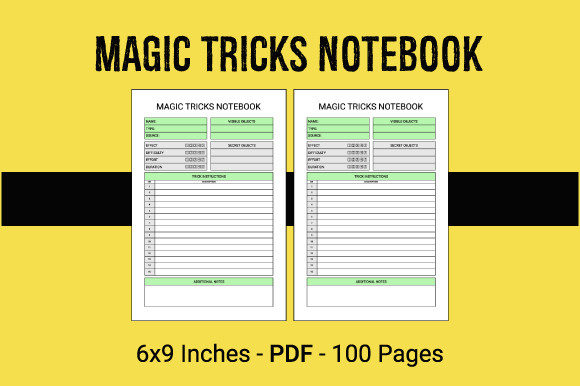
For publishers operating within the Amazon Kindle Direct Publishing ecosystem, finding a niche that balances specific audience interest with functional utility is often the primary challenge. The Magic Tricks Notebook KDP Interior represents a specialized subset of low-content publishing that moves beyond generic lined journals. This digital asset typically provides a pre-formatted, 100-page PDF designed specifically for magicians, illusionists, and hobbyists to document routines, track sleight-of-hand progress, or plan performances. Unlike standard notebooks, this interior offers structured prompts or layouts relevant to the craft of magic, making it a distinct product category within the broader journal market.
When considering this resource for a Print on Demand business, it is essential to understand its technical specifications and market positioning. The standard configuration includes 6″ x 9″ dimensions, which is the industry benchmark for portable notebooks. The file is provided as a high-resolution PDF with no bleed settings, ensuring compatibility with KDP’s printing requirements without requiring advanced graphic design adjustments. For publishers aged 20 to 50 who are evaluating whether to add this specific interior to their catalog, the decision rests on understanding how this specialized format compares to generalist alternatives and whether it aligns with current demand signals in the performance arts niche.
Distinguishing Features Against Generic Journal Interiors
The primary value proposition of a Magic Tricks Notebook KDP Interior lies in its specificity. When comparing this asset to standard college-ruled or dot-grid interiors, the distinction is functional rather than aesthetic. A generic notebook serves any user, but it offers no inherent guidance. In contrast, a magic-specific interior acts as a semi-structured tool. It may include sections for listing props, scripting patter, diagramming hand positions, or rating the difficulty of specific sleights. This transforms the book from a passive repository of notes into an active practice log.
From a competitive standpoint, this specialization creates a barrier to entry against oversaturated markets. While "notebook" is a highly competitive keyword with millions of results, "magic trick practice journal" or "illusionist notebook" occupies a long-tail position with significantly lower competition. However, this also means a lower total addressable market. Publishers must weigh the benefit of higher conversion rates due to relevance against the limitation of lower overall search volume. The 100-page count included in these ready-to-use files is generally considered the sweet spot for this niche; it provides enough bulk to feel substantial and justify a mid-tier price point without becoming too heavy for a performer to carry to rehearsals or gigs.
Technical Suitability and Production Constraints
The technical execution of these interiors directly impacts the final product quality and the publisher's workflow. The specified 6″ x 9″ dimension with no bleed is a deliberate choice for functionality. Magicians often need to reference notes quickly during practice sessions or backstage. A trim size larger than 6x9 can be cumbersome, while smaller sizes may not offer adequate space for diagramming complex hand movements or writing out lengthy scripts. The no-bleed specification simplifies the upload process and reduces the risk of critical content being trimmed during the binding phase, which is particularly important for interiors containing precise lines or boxes near the page edges.
High-resolution PDF delivery ensures that text remains crisp and lines appear sharp after printing. KDP’s standard paper stock is 55# cream or white, which can sometimes reveal ink bleed-through if designs are too heavy. Quality magic notebook interiors account for this by using appropriate line weights and avoiding solid black backgrounds. When evaluating different ready-to-use files, publishers should verify that the interior margins adhere to KDP’s minimum gutter requirements for a 100-page book. A common failure point in low-content publishing is utilizing a template with insufficient inner margins, resulting in text disappearing into the spine. Because this specific asset is marketed as "ready to use," verifying these safety zones before publication is a critical quality assurance step.
Comparative Analysis: Specialized vs. Custom vs. Generalist
Publishers typically face three options when entering the magic niche: using a pre-made Magic Tricks Notebook KDP Interior, creating a custom interior from scratch, or adapting a general planner. Each approach carries distinct tradeoffs regarding time investment, cost, and market fit.
- Pre-Made Ready-to-Use Files: This option offers immediate speed to market. The 100-page PDF is formatted and ready for cover integration. The advantage is efficiency; a publisher can test the niche viability within hours. The tradeoff is lack of exclusivity. Other sellers may use the same license, potentially leading to duplicate content issues if the licensing terms are not strictly managed or if the platform flags similar interiors.
- Custom-Created Interiors: Designing a unique layout allows for complete intellectual property ownership and differentiation. A publisher could interview local magicians to create a truly bespoke logging system. The downside is the significant time and skill requirement. Creating a professional, print-ready 100-page document requires proficiency in InDesign or Affinity Publisher and a deep understanding of typography and binding mechanics.
- Adapted General Planners: Some publishers attempt to repurpose generic planners by simply changing the cover title. While this saves design time, it often results in poor user experience. A daily hourly planner does not accommodate the non-linear nature of magic practice. Users in this niche are discerning; if the interior does not reflect the actual workflow of learning illusions, negative reviews regarding "misleading content" are likely.
For those new to the niche or testing multiple categories simultaneously, the pre-made Magic Tricks Notebook KDP Interior serves as a valid minimum viable product. It allows for market validation without upfront design costs. If sales data indicates strong demand, reinvesting profits into custom design becomes a logical next step. Conversely, if the niche proves dormant, the financial loss is minimized compared to commissioning custom artwork.
Audience Fit and Use Case Evaluation
Understanding who actually buys these notebooks is vital for effective metadata optimization and cover design. The audience for magic notebooks is not monolithic. It generally segments into three groups: beginners learning card mechanics, intermediate performers refining stage acts, and professionals documenting show logistics. A single 100-page interior rarely serves all three equally.
Beginners typically require repetitive drill logs and space for basic terminology definitions. Intermediate users often need script formatting and prop checklists. Professionals may prioritize setlist organization and venue notes. When selecting a ready-to-use PDF, publishers should assess which segment the interior targets. An interior filled with complex stage diagrams will alienate beginners, while one focused solely on card flourishes will fail to capture stage illusionists. The most versatile Magic Tricks Notebook KDP Interior options often employ a hybrid structure: a mix of lined pages for freeform notes, tabular pages for tracking practice duration, and blank space for visual diagrams. This flexibility broadens the potential customer base within the niche.
Furthermore, the gift-giving aspect of this niche cannot be overlooked. Many purchases occur during holiday seasons or graduation periods, bought by friends or family members of aspiring magicians. These buyers rely heavily on the book description and "Look Inside" feature to judge suitability. They are looking for cues that the book is "legitimate" and not just empty paper. Highlighting specific features like "routine planning templates" or "sleight tracking charts" in the product description helps bridge the knowledge gap for non-magician buyers.
Strategic Considerations for Implementation
While the interior provides the foundation, commercial success depends on how the product is packaged and positioned. The "just add a cover" instruction associated with these files should be interpreted as a starting point, not a finish line. Cover design in the magic niche requires balancing mystery with clarity. Overused tropes like top hats and rabbits can signal low quality or children's products. Successful covers often utilize elegant typography, subtle iconography (wands, cards, coins), and matte finishes that suggest professionalism. The cover must visually communicate that the interior contains specialized tools, distinguishing it from a standard diary.
Publishers should also consider the bundling potential of these assets. Since the file is a standard 6x9 PDF, it can be easily adapted into other formats. Creating a companion version in a larger 8.5x11 size for desk-based study, or a pocket-sized 5x8 version for travel, can expand the product line using the same core content. Additionally, because the file is high-resolution, select pages can be extracted and used as promotional images in Amazon Ads or social media marketing to demonstrate the interior's utility to potential buyers.
Finally, ongoing evaluation is necessary. The low-content landscape shifts rapidly. What works today may become saturated tomorrow. Publishers utilizing ready-to-use Magic Tricks Notebook KDP Interior files should monitor review feedback closely. Comments requesting specific features—such as "wish there was a section for linking tricks" or "needs more space for diagrams"—provide direct market research. These insights inform future iterations or custom designs, turning a static digital asset into a dynamic component of a responsive publishing strategy. By treating the pre-made interior as a data-gathering tool rather than just a revenue stream, publishers can build sustainable expertise in the performance arts niche.