Evaluating the Amazon KDP Interior Templates Set for Commercial Publishing
For self-publishers and digital entrepreneurs, the barrier to entry in low-content book publishing has lowered significantly, but the standard for quality has risen. Sourcing reliable, editable interiors is no longer just about finding blank pages; it is about securing assets that offer commercial flexibility and professional presentation. The Amazon KDP Interior Templates Set addresses this specific need by providing a bundle of five distinct, fully editable templates designed for commercial use. Rather than offering generic placeholders, this collection targets high-demand niches with print-ready files that integrate directly into modern design workflows.
This resource is particularly relevant for creators who understand that success on Amazon KDP relies on differentiation. Using static, non-editable PDFs often leads to duplicate content issues or books that look indistinguishable from thousands of others. By utilizing a set where every element—from fonts to colors—is modifiable, publishers can maintain brand consistency across multiple titles while ensuring each product meets current marketplace standards. The inclusion of diverse categories, ranging from educational tracing books to functional logs, suggests a strategic approach to portfolio building rather than a single-niche focus.
Breakdown of Included Template Assets
The practical value of any digital asset bundle lies in the specific utility of its components. This set includes five distinct templates, each serving a different segment of the low and medium-content market. Understanding the application of each helps determine if the bundle aligns with your current publishing strategy.
- Activity Log Book: Functional tracking books remain a staple in the KDP ecosystem. This template provides a structured layout for recording daily tasks, hobbies, or fitness metrics. Its value lies in its clean grid systems and header placements, which are often tedious to format manually. For publishers targeting productivity or wellness niches, this serves as a foundational interior that can be rebranded for specific audiences, such as gardeners, writers, or athletes.
- Address Book: Despite the digital age, physical address books retain a loyal demographic, particularly among older adults and those seeking digital detox tools. This template offers pre-formatted fields for contact information. The editability here is crucial; users can adjust field labels to include modern data points like social media handles or website URLs, updating a traditional format for contemporary use.
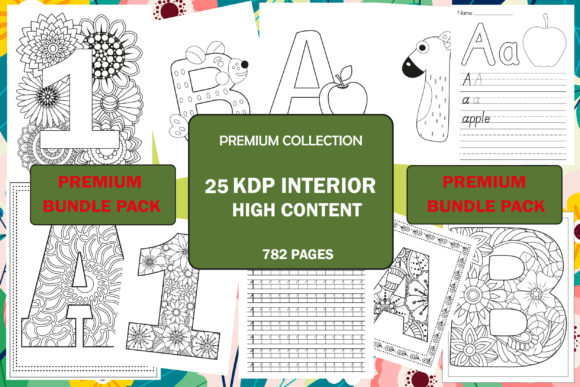
- Airplane Coloring Pages: The children’s activity niche is competitive, making unique artwork essential. These coloring pages provide line art specifically themed around aviation. Because they are editable, publishers can combine these with other elements, add educational facts about aircraft, or adjust the line weight to suit different paper qualities. This moves the product beyond a simple coloring book into potential educational or gift categories.
- Number Tracing Book (1-50): Early childhood education materials require precise formatting to be effective. This template covers numbers one through fifty, providing guided practice space. The ability to edit allows creators to modify the font style to match specific handwriting curricula or to add visual aids that reinforce number recognition. It is a technical interior where alignment and spacing are critical, saving significant layout time.
- Number Puzzles: Puzzle books generate higher engagement and perceived value than simple tracing books. This template introduces cognitive challenges alongside basic numeracy. From a business perspective, puzzle interiors often command higher price points. Having an editable source file means you can regenerate puzzles or alter difficulty levels, preventing your book from becoming stagnant in search results.
Workflow Integration and Canva Compatibility
A major friction point in KDP publishing is software compatibility. Many interior templates are sold as flattened PDFs or in proprietary formats that require expensive Adobe licenses. This Amazon KDP Interior Templates Set is explicitly optimized for Canva, acknowledging that many independent publishers rely on this accessible platform. The workflow is designed to be linear and efficient, reducing technical overhead.
The process begins with downloading the provided PDF files. Unlike rasterized images, these PDFs retain vector-like properties when uploaded to Canva. Upon signing into the free version of Canva, users upload the file directly. The platform recognizes the individual elements within the template, allowing for granular control. You are not merely overlaying text on a background; you can modify the underlying design color, swap fonts to match your series branding, and resize structural elements.
Furthermore, the integration allows for asset enhancement. Canva’s library of free elements can be dragged and dropped directly onto these templates. This means a user could take the Airplane Coloring Pages and add cloud backgrounds, or enhance the Activity Log with custom icons without leaving the browser. Once modifications are complete, the file is saved and downloaded as a print-ready PDF. This seamless loop between template and editor ensures that the final output maintains the correct bleed, margins, and resolution required by Amazon’s printing partners.
Commercial Viability and Customization Depth
The designation of "Commercial Use" is the most critical attribute for professional publishers. This license grants the right to use these templates as the basis for products sold on Amazon KDP without royalty obligations or attribution requirements. However, the true commercial viability stems from the depth of customization permitted.
In the current KDP landscape, uploading unmodified templates carries risk. Amazon’s algorithms increasingly prioritize unique customer experiences, and duplicate interiors can lead to suppressed listings. Because every aspect of this Amazon KDP Interior Templates Set is editable, it functions as a skeleton rather than a finished skin. Publishers can alter page counts, rearrange sections, and completely restyle the aesthetics. This capability transforms a single purchase into potentially dozens of unique SKUs.
For example, the Number Tracing Book could be adapted into a bilingual edition, a special needs resource with larger spacing, or a themed workbook incorporating stickers and rewards charts. The Address Book could be pivoted into a client management tool for real estate agents or a genealogy tracker for family historians. This flexibility extends the return on investment far beyond the initial cost, provided the user invests the necessary time in genuine customization.
Practical Considerations and Quality Assessment
While the versatility of this set is a strength, prospective users should approach it with realistic expectations regarding production effort. "Fully editable" implies a responsibility to edit. Users who simply change the title and upload the file are unlikely to see sustainable sales. The templates provide professional structure, but market success depends on the creator's ability to identify niche-specific needs and adapt the interiors accordingly.
Quality control remains the publisher's responsibility. While the templates are described as print-ready, any significant modification in Canva requires a final pre-flight check. Users must verify that margins remain safe after moving elements, that text contrast meets accessibility standards, and that exported PDFs adhere to KDP’s specific size requirements. The templates solve the blank page problem, but they do not automate quality assurance.
Additionally, while Canva is a powerful tool, it has limitations compared to professional typesetting software. Complex multi-page changes, such as globally updating a header across 100 pages, may require more manual intervention in Canva than in InDesign. Publishers planning to create extensive series should factor this workflow nuance into their production timelines. The set is ideal for agile publishing and testing new niches, but high-volume producers should establish efficient batch-processing habits within the Canva environment.
Target Audience and Strategic Fit
This Amazon KDP Interior Templates Set is best suited for intermediate publishers and serious beginners who have moved past the experimental phase and are ready to build a catalog. It offers particular value to educators creating supplementary materials, freelancers building passive income streams, and small business owners looking to create branded merchandise or lead magnets in book form.
It is less suitable for those seeking automated, zero-effort income or for advanced typographers who prefer building layouts from scratch in vector software. However, for the vast majority of KDP creators who need professional-grade starting points that respect commercial licensing and platform compatibility, this bundle represents a pragmatic solution. It balances cost-efficiency with the creative freedom necessary to compete in a maturing marketplace.
Ultimately, the decision to acquire this set should be based on workflow efficiency. If you find yourself spending hours drawing table grids or sourcing individual coloring pages, this bundle consolidates those tasks into a single, cohesive asset. By streamlining the technical foundation of book creation, it frees up mental bandwidth for keyword research, cover design, and marketing strategies that actually drive visibility. In an ecosystem where speed and quality must coexist, having reliable, editable infrastructure is not just a convenience—it is a competitive advantage.