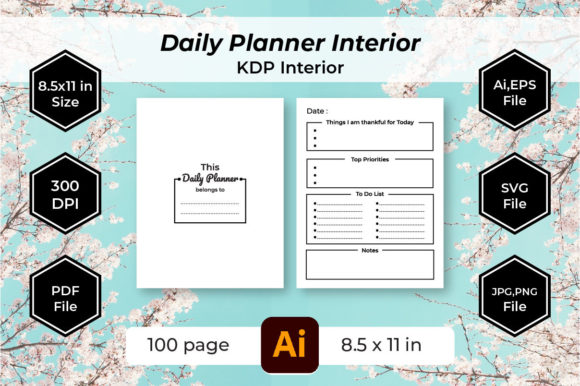
Designing for Success: Technical and Strategic Insights on the Daily Planner KDP Interior 8.5x11
The low-content publishing landscape has evolved from simple lined notebooks to sophisticated productivity tools that rival traditional publishing houses. For creators entering this space, the foundation of a successful product lies not merely in the cover design but in the functional architecture of the interior. A Daily Planner - KDP Interior - 8.5x11 represents the industry standard for productivity journals, offering a canvas size that balances portability with ample writing space. Understanding the technical specifications and user experience requirements of this format is essential for producing a book that generates positive reviews and repeat customers.
The Functional Anatomy of a Productive Layout
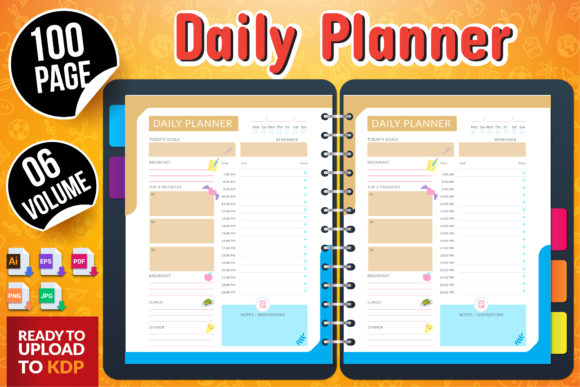
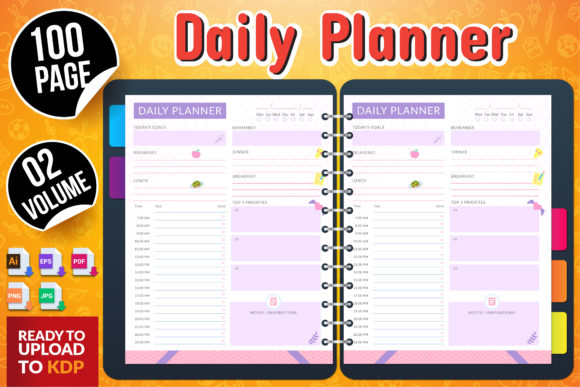
When evaluating or creating a Daily Productive Planner, one must look beyond aesthetics to assess utility. The 8.5 x 11-inch dimension is particularly significant because it allows for complex layouts that smaller trim sizes cannot accommodate without feeling cluttered. A high-quality interior typically integrates several distinct zones on a single page to facilitate cognitive organization.
- Prioritization Matrix: Effective planners often include a dedicated section for top three priorities or an Eisenhower matrix. This moves the user from passive list-making to active decision-making.
- Time-Blocking Schedules: Vertical hourly slots allow users to visualize their day chronologically. In an 8.5x11 format, these blocks can be spacious enough to write detailed appointments rather than just keywords.
- Wellness and Habit Tracking: Modern planning intersects with self-care. Integrated water intake logs, mood trackers, or gratitude prompts increase the perceived value of the journal.
- Reflective Spaces: End-of-day review sections transform a simple scheduler into a tool for personal growth and continuous improvement.
For KDP publishers, ensuring these elements are present in the Kdp Template is crucial. Users are increasingly discerning; they seek interiors that solve specific organizational pain points rather than generic lines. The inclusion of editable source files, such as AI or EPS vectors, allows publishers to customize these functional zones to target niche audiences, such as teachers, nurses, or entrepreneurs, thereby differentiating their product in a saturated market.
Technical Specifications and Print Readiness
A common failure point in low-content publishing is neglecting the technical constraints of print-on-demand technology. Even the most beautiful design will fail if the file is not properly formatted for Amazon’s printing presses. When working with a Daily Planner KDP Interior, adherence to strict technical standards is non-negotiable.
Resolution and Color Profiles
All interior files must be exported at 300 DPI (dots per inch). While digital screens display images clearly at 72 or 96 DPI, print requires higher density to prevent pixelation or blurriness. This is especially critical for fine lines, checkboxes, and small text often found in planner layouts. Furthermore, understanding color profiles is vital. KDP interiors for standard planners are typically black and white. Designers must ensure their files are in grayscale or CMYK mode optimized for black ink output. Using rich RGB blacks can sometimes result in muddy printing or unexpected gray tones when converted by the printer's RIP software.
Margins and Bleed Considerations
The 8.5 x 11 trim size requires precise margin calculations. For a planner, where users need to write near the binding, the inside margin (gutter) must be generous. A common mistake is using symmetrical margins; however, a Journal Interior requires a wider gutter margin to account for the curvature of the spine. If the book is 100 pages, a gutter of at least 0.375 inches is recommended, though many professional designers prefer 0.5 inches to ensure a premium feel. If the design includes elements that extend to the edge of the page, bleed settings (typically 0.125 inches added to the outer edges) must be applied correctly in the source file to avoid white borders after trimming.
Leveraging Editable Source Files for Niche Customization
One of the most significant advantages of acquiring a comprehensive asset package—including Editable Source File Ai, Vector Source File EPS, and SVG formats—is the ability to iterate rapidly. Static PDFs limit a publisher to a single product, whereas vector files enable the creation of an entire ecosystem of related journals.
Vector graphics differ from raster images (like JPG or PNG) in that they are mathematically defined paths. This means they can be resized infinitely without losing quality. For a Kdp Planner Interior, this scalability is essential. A designer might take a base 8.5x11 layout and adapt it for a 6x9 travel planner or an 8x10 academic journal simply by adjusting the artboard size and reflowing the vector elements. This flexibility drastically reduces production time and ensures visual consistency across a brand’s catalog.
Moreover, editable files allow for localization and language translation. A planner designed for the US market can be easily adapted for international markets by changing date formats (MM/DD/YYYY vs. DD/MM/YYYY) or translating headers, expanding the potential customer base without redesigning from scratch. This capability transforms a single Kdp Pdf purchase into a long-term business asset.
User Experience and Market Positioning
Success in the KDP space is ultimately determined by how well the product serves the end-user. When selecting or designing a Daily Schedule layout, consider the tactile experience of writing. Line weight matters significantly; lines that are too dark can feel oppressive and distract from the user's handwriting, while lines that are too light may not scan well or provide enough visual guidance. Professional interiors often use a dot grid or light gray ruled lines (between 10% and 20% opacity) to strike this balance.
Paper Quality and Opacity Management
Amazon’s standard white paper is 55# (90 GSM), which is relatively thin compared to premium stationery. Designers must account for potential ghosting or bleed-through. High-contrast solid black shapes should be used sparingly on the reverse side of a page. If a page features heavy ink coverage, the opposite page should ideally be lighter or feature a pattern that masks potential show-through. Understanding these physical limitations helps in creating a Print Ready file that feels higher quality than its material cost suggests.
Target Audience Alignment
The versatility of the 8.5x11 format makes it suitable for diverse demographics, but specificity sells. A general "Daily Planner" faces immense competition. However, utilizing the editable nature of Interiors Kdp assets allows for strategic pivoting:
- Educators: Modify the daily schedule to align with class periods and add sections for lesson planning or student notes.
- Healthcare Professionals: Incorporate shift-based scheduling, patient log areas, and medication tracking reminders.
- Remote Workers: Add sections for digital detox tracking, zoom meeting logs, and home-office task separation.
- Students: Integrate assignment trackers, exam prep schedules, and GPA calculators alongside the daily view.
By tailoring the metadata and the interior content to these specific sub-niches, publishers can capture search traffic with lower competition and higher conversion intent. The tags associated with the product, such as Adults Interiors, Journal Tutorial Making, or Low Content Interiors, should reflect this targeted approach rather than relying solely on broad terms.
Workflow Integration for Publishers
Incorporating a pre-made Kdp Interior into a publishing workflow requires a systematic approach to quality assurance. Before uploading any Customizable Pdf to KDP, publishers should utilize digital proofing tools and, ideally, order a physical proof copy. Digital previews cannot accurately simulate gutter loss or paper texture. Checking the alignment of left and right pages in a physical proof ensures that the writing space remains consistent throughout the book.
Additionally, maintaining an organized library of assets is crucial for scaling. Since packages often include multiple file types (AI, EPS, SVG, PNG, JPG), establishing a clear naming convention and folder structure prevents version control issues. Keeping the original vector masters separate from the flattened print-ready PDFs ensures that future edits can be made without degrading image quality. This organizational discipline is what separates hobbyists from sustainable KDP business owners.
The integration of high-quality, technically sound interiors serves as the backbone of a reputable low-content publishing business. By focusing on the intersection of user-centric design, rigorous technical compliance, and strategic customization, publishers can elevate their offerings above the noise of generic alternatives. The Daily Planner - KDP Interior - 8.5x11 is more than just a template; it is a foundational tool that, when utilized with expertise and intention, facilitates both personal productivity for the user and commercial viability for the creator.